This article contains affiliate links. We may earn a commission if you make a purchase through our links, at no extra cost to you.
Key Takeaways
- Proprioceptive input runs in both directions — the same pushing, pulling and carrying that settles an overwhelmed child can wake up a sluggish one.
- Scheduled input beats rescue attempts. Two minutes before the hard moment does more than twenty in the middle of one.
- The window is the run-up, not the peak. Pacing, repeated questions, sudden stillness — that is your cue.
- Offer two choices, not one instruction. A dysregulated child can often choose when they can no longer comply.
- During a full meltdown, subtract — lower demands, noise and light. Pressure is offered, never imposed.
Proprioceptive input calms by giving the brain strong, unmistakable feedback from muscles and joints — the pushing, pulling, carrying and squeezing of working against resistance. For many children that feedback lowers arousal and organises attention. The catch is timing: it works best offered before a hard moment, not in the middle of the worst one.
Most parents get handed the first half of that and none of the second. "Try heavy work" is advice with a missing manual. This is the manual — when to deploy it, how to offer it so it gets accepted, and when the right move is to offer nothing at all. For the theory and the equipment, start with our complete proprioceptive input guide.
Why Proprioceptive Input Calms — And Why It Also Works in Reverse
Proprioceptors are the receptors inside muscles, tendons and joints that report on movement and position. According to the NAPA Center, "proprioceptive input is also one of the main regulators in the body, which means it helps to calm an active nervous system and can help to organize a child if they feel overstimulated by an environment." There is measured evidence at the pressure end: a 2022 study in Bioengineering, published via PubMed Central, gave 20 autistic children aged 4 to 13 a portable deep-pressure seat on a public bus; in the group using the inflatable version, the researchers recorded a significant fall in heart rate and skin conductance during treatment.
Here is the part that gets left out: proprioception works in both directions. The OT Toolbox, which calls this input "organizing and regulating," describes weight-bearing as satisfying "the need for strong input" in children who seek intense movement while giving children who feel "disorganized or restless" feedback that increases body awareness and stability. Same activity, opposite starting points — the child bouncing off the walls and the child melting into the sofa can both be handed a laundry basket.
It is also the safer bet. Chicago Occupational Therapy notes that too much vestibular input can be overstimulating, and suggests following a movement activity with proprioceptive input if a child looks overstimulated. We cover the trade-offs in how proprioceptive and vestibular input differ.
What the Research Says
Be wary of anyone calling this settled science. A 2025 systematic review of randomized controlled trials in the American Journal of Occupational Therapy, Acuña et al., found that when Ayres Sensory Integration is delivered under fidelity, autistic children significantly improved on their own individualized goals for occupational performance, function and participation — while the evidence indicated no benefit for "behaviors of concern" such as noncompliance or irritability. Isolated tools fare worse: the Case-Smith et al. review in Autism (2015) found few positive effects for single-sensory, classroom-based tools such as weighted vests and therapy balls. The support is for tailored programmes aimed at goals you choose.
Proactive Beats Reactive: The Sensory Diet Idea
The most useful reframe we can offer: stop treating heavy work as a fire extinguisher and start treating it as a meal schedule.
That is the sensory diet idea. As the National Fragile X Foundation describes it, a sensory diet is "a treatment that includes activities tailored specifically for each child's or adult's (and their family's) specific sensory processing issues," built around "a schedule of the key events in the individual's day" with the goal of reaching and maintaining an appropriate level of arousal. It also notes what gets skipped in most retellings: a sensory diet is designed by family and therapist together, under an occupational therapist's supervision.
Scheduled means scheduled. Not "when he starts to lose it."
- Anchor input to events, not clock times. Before the school run. After the bus. Before homework opens.
- Short counts. Two to five minutes — ten wall push-ups — is usually enough to be worth doing. This is not a therapy session, and there is no established dose.
- Keep it boringly identical. A child who knows "we do the couch push before homework" is following a routine, not receiving a correction.
- Two or three fixed slots beat twelve improvised ones.
One caveat: the evidence above supports tailored programmes with goals you and a therapist set, not a schedule copied off the internet. Treat what you build as a hypothesis, and bin what does nothing.
Reading the Early Warning Signs
Timing is the whole game, and the window opens earlier than most of us think.
The National Autistic Society describes a "rumble stage" before a meltdown, in which a person may "start to exhibit signs of anxiety such as pacing, seek reassurance through repetitive questioning or physical signs such as rocking or becoming very still." The Organization for Autism Research frames the same escalation as a three-stage cycle — rumbling, rage, recovery — with rumbling being where intervention actually works.
Your child's rumble signs are theirs alone, and rarely dramatic. Common ones parents report:
- Voice gets louder, flatter or faster
- Movement changes — pacing, bouncing on toes, tapping, sudden freezing
- The same question, asked four times
- Rigidity about something small: the wrong cup, a seam in a sock
- Chewing, pulling at clothes, hands to ears
Write your child's three most reliable signs on a sticky note. Once you can name the rumble, you have a job you can do. After the peak, mostly you do not.
A Regulation Routine You Can Actually Run
Four steps. Under five minutes, and better the more predictable it is.
- Notice and name it low-key. "Your body looks like it needs something." No lecture, no eye contact demanded. The Child Mind Institute describes co-regulation as helping a child manage emotions by staying calm yourself — a calm caregiver directly influences a child's stress response.
- Offer two options, never one instruction. "Wall pushes or the laundry basket?" A dysregulated child can often choose when they can no longer comply. The Child Mind Institute suggests giving two options rather than one demand, on the grounds that it reduces the negotiating that leads to tension.
- Give it time and say nothing. Two to five minutes. No coaching, no counting reps — talking is another demand.
- Reflect much later. At bedtime, or the next day: "That thing with the basket seemed to help. Want to keep it?" Children are usually more willing to use a plan they helped build.
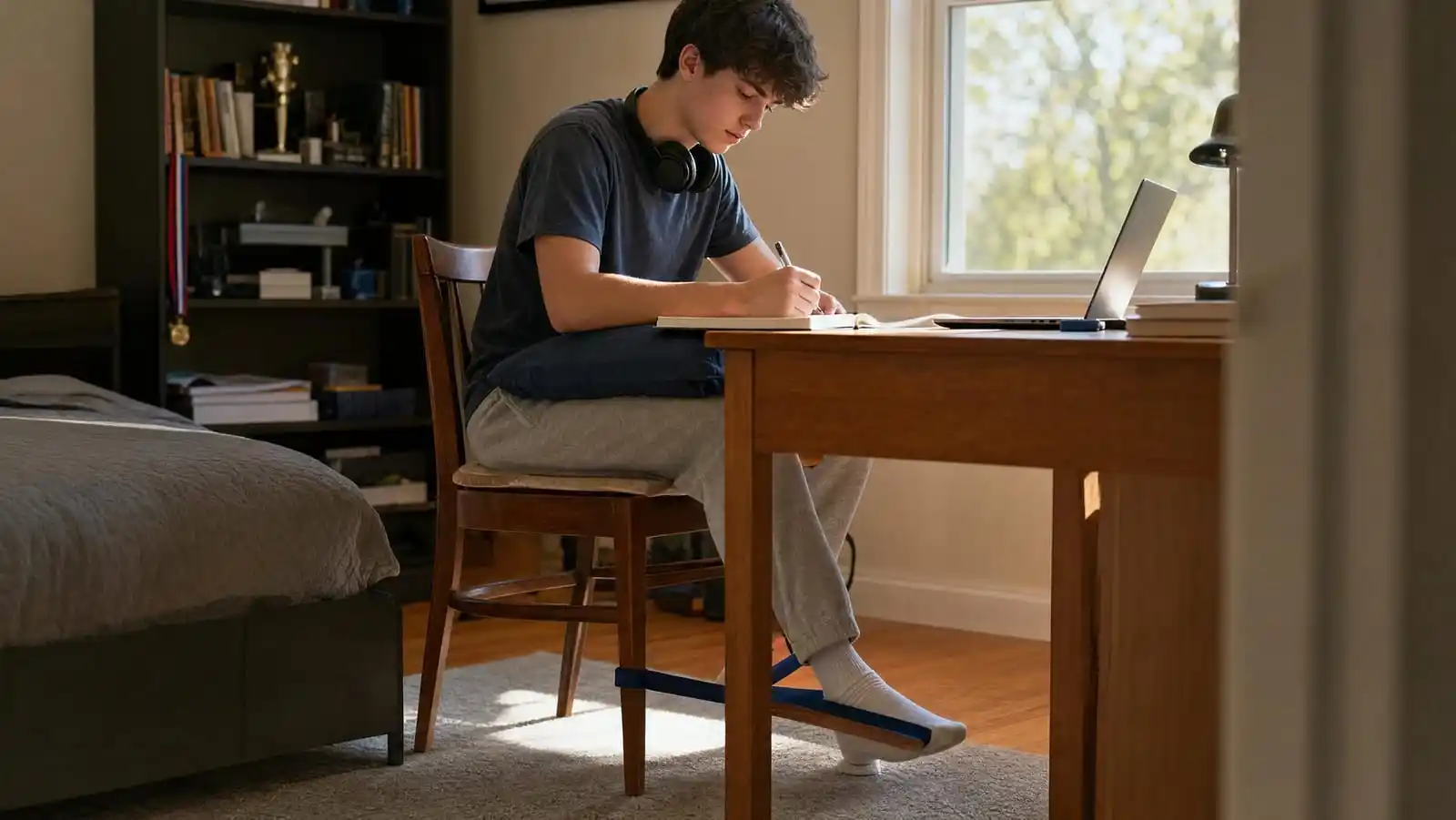
Deep pressure belongs on that step-two menu — a firm squeeze, a squash under a couch cushion, a snug blanket roll. Deep pressure therapy at home covers how to offer it well. The non-negotiable: your child chooses it, controls "harder," "softer" and "stop," and can get out at any second.
Input Menus by Situation
Pick one per situation and use it until it is dull.
| Situation | Input that often helps (2–5 min) | |---|---| | Morning, out the door | Wall push-ups, carry the recycling out, backpack on early for a lap of the house | | Before homework | Chair push-ups, palms pressed hard together, push against the desk, cold firm dough | | After school | Snack first, then climbing, crashing into cushions, carrying the groceries in | | Transitions and waiting | Hands pressing into pockets, squeezing a water bottle, carrying the bag, chair squats | | Meltdown recovery | Blanket roll, cushion squash, slow crawling games — offered, not required | | Bedtime wind-down | Animal walks down the hall, a firm squash under a cushion, then lights down |
Before focused work, the common mistake is running heavy work and then expecting forty minutes of stillness. The settle is short — a runway, not a fuel tank. Do the input, start immediately, and plan the next burst before it wears off. Something to hold during the work helps many children; see fidget toys for focus.
After school, what pediatrician Tony GiaQuinta describes for Parkview Health as after-school restraint collapse is common, and it is not defiance: "the energy required to hold it together all day long takes its toll," and it has to go somewhere. A child who worked at holding it together all day arrives home with little left, so food and ten low-demand minutes come first. If school itself is where things unravel, see proprioceptive input in the classroom.
At bedtime, heavy work settles some children and lights up others. If yours is in the second group, move the exertion to an hour before bed and keep the last twenty minutes to pressure and touch — see our bedtime wind-down routine and tactile tools for calming down. For more, we have twenty heavy work activities you can do at home.
What to Do During an Actual Meltdown
A meltdown is not a tantrum. The National Autistic Society defines a meltdown as "an intense response to an overwhelming situation" in which someone "temporarily loses control of their behaviour," and adds that it "is not the same as a temper tantrum. It is not bad or naughty behaviour." A tantrum is goal-directed and ends when the goal is met. A meltdown runs its course.
Once a child is at the peak, adding new sensory input is usually the wrong move — they are already past capacity. The National Autistic Society's guidance is to subtract: give them time, because "it can take a while to recover from information or sensory overload"; create a quiet, safer space; turn off loud music and turn down bright lights; do not judge or crowd them. The Child Mind Institute makes the parallel point about talking — it is not effective to reason with a dysregulated child until their rational faculties come back online.
So at the peak:
- Safety first. Move furniture, not the child, where you can.
- Cut demands to zero. No questions, no instructions, no consequences, no "use your words."
- Cut sensory load. Lights down, sound off, people out, space around them.
- Stay near and stay calm. Presence without pressure.
Proprioceptive input belongs to the two stages either side: the rumble and the recovery. Afterwards — sometimes half an hour afterwards — many children will accept a blanket roll or a cushion squash, and it seems to help them come the rest of the way down.
One line we will not soften: pressure is offered, never imposed. Do not hold, pin, wrap or squeeze a child who is dysregulated and has not asked for it. Physical pressure applied to a child who cannot escape it is restraint, not therapy. If your child is regularly unsafe to themselves or others, that is a signal to get professional support, not to press harder.
Tracking What Works
Two weeks of scrappy notes beat two months of guessing. One line, on your phone: what happened, what you offered, what changed in the next 20 minutes. "4:15, wired after school, laundry basket push x3, sat for snack" is enough.
After a fortnight you can usually see which activities do nothing, which times of day are your real pressure points, and which inputs wind your child up. Bring the log to your OT — a therapist can do far more with that than with "we tried heavy work and I think it helped sometimes."
Safety Notes
- Child-led, always. If they do not want it, it is not happening today. Offer twice, then drop it.
- Firm is never painful. Deep pressure should feel like a good hug. Stop the second they want to stop.
- Never over the head, face or neck, and never on a child who cannot move away or tell you to stop.
- Weighted tools need OT guidance. Gillette Children's advises that a weighted blanket be no more than 10% of a child's body weight, used only with adult supervision, and never by a child under two. GriffinOT's weighted blanket guidance adds that the child must be able to get themselves back out independently, and that weighted items "should never be used as a restraint."
- Supervise crashing, jumping and climbing. A crash pad is a safe target; a coffee table is not.
- Check first if there is a medical picture. Talk to your pediatrician or OT before starting if your child has low muscle tone, hypermobility, a seizure disorder, a heart or breathing condition, or a recent injury.
When to Bring in an OT
Home strategies are a support, not an assessment. Look for an occupational therapist with sensory integration training when regulation is affecting daily life — school, meals, sleep, friendships — when your child's response to input is inconsistent, or when you are organising your week around avoiding hard moments. That is where the research is clearest: tailored programmes aimed at goals you choose.
Frequently Asked Questions
How long does the calm last after heavy work?
It varies enormously, and nobody can give you a reliable number. Many parents and OTs describe a window of roughly twenty minutes to a couple of hours — which is why input works best placed immediately before the thing you need it for.
How often should we do this?
There is no established dose, and be sceptical of any source handing you one as a fact. Most families start with two or three fixed slots tied to the hardest moments of the day and adjust. An occupational therapist will set frequency based on what they observe.
Does proprioceptive input work during a meltdown?
Generally no, and that is the most important thing on this page. At the peak a child is past the point of taking in new input, and the National Autistic Society's guidance is to reduce demands and sensory load rather than add to them. Use proprioceptive strategies in the run-up and again in recovery.
What if it winds my child up instead of calming them?
That happens, and it does not mean you did it wrong. Some children ramp up before they settle; others are over-alerted by fast, bouncy activities. Shift toward sustained, slow effort — pushing, pulling, carrying, squashing — and away from jumping, crashing and spinning. If it still escalates, drop it and tell your OT.
Can this replace occupational therapy?
No. These are between-appointments supports, and the evidence is strongest for tailored programmes rather than tools used alone. If regulation is affecting daily life, an assessment gives you what a checklist cannot: a plan built around your child's profile and your family's actual week.
The Short Version
When proprioceptive input disappoints, the problem is usually timing rather than technique. Put it before the hard moment. Offer two choices instead of one instruction. Watch for the rumble instead of the peak. And when a meltdown is underway, do less — quieter, dimmer, fewer words — and save the input for recovery.
No routine prevents every hard moment, and any source suggesting otherwise is selling something. What a good one does is shift the odds and shorten the recovery.
For the full picture — how proprioception works, which tools are worth buying and which are not — read our complete guide to proprioceptive and heavy work tools.