This article contains affiliate links. We may earn a commission if you make a purchase through our links, at no extra cost to you.
Key Takeaways
- Deep pressure therapy is firm, even, sustained pressure — hugs, cushion squishes, blanket wraps — to help an overwhelmed nervous system settle.
- The most effective version costs nothing. Your hands, a couch cushion and a blanket do most of the work.
- Firm, never painful. Offered, never imposed. A child who squirms away or goes rigid is answering the question.
- Short and repeated beats long and forced, and effects can outlast the session.
- Weighted products carry documented, fatal risks. Sizing, supervision, and a child who can remove the item themselves are non-negotiable.
Deep pressure therapy is firm, even, sustained pressure applied to the body — a tight hug, a cushion squish, a snug blanket wrap, your own two hands — used to help a wound-up or overwhelmed child feel settled again. Almost all of it can be done at home tonight, with no equipment, no training and nothing bought.
Most articles on this topic try to sell you a blanket in the opening paragraph; we would rather show you the free version first. This is the deep pressure chapter of our broader guide to heavy work and proprioceptive input — read that one for the full picture, this one when you need something to try in the next ten minutes.
What Deep Pressure Actually Is
Deep touch pressure (DTP) is a specific kind of tactile input, and the distinction from ordinary touch is the whole point. In her much-cited 1992 paper in the Journal of Child and Adolescent Psychopharmacology, Temple Grandin describes it as "the type of surface pressure that is exerted in most types of firm touching, holding, stroking, petting of animals, or swaddling," in contrast to light touch pressure, "a more superficial stimulation." Her summary is the line occupational therapists end up repeating to parents: "A very light touch alerts the nervous system, but deep pressure is relaxing and calming."
That is why a feather-light hand on the shoulder can make a sensory-sensitive child jump out of their skin while a full-body squeeze makes them melt — a split we unpack in deep pressure vs. light touch. Pediatric occupational therapist Kim Griffin, with over 25 years of clinical experience, puts it the same way: light touch alerts the body to danger, while touch pressure "has the opposite effect on the nervous system and helps it to calm down."
What the Research Says — and Doesn't
The calming explanation has some experimental support. A crossover randomized controlled trial in Frontiers in Integrative Neuroscience, hosted on PubMed Central, found a significant rise in a heart-rate-variability marker of parasympathetic ("rest and digest") activity after a 90-second deep-touch hold, but not after joint mobilization or rest. The 35 participants were healthy adult undergraduates, not children.
Evidence for deep pressure as a product is weaker. A meta-analysis by Losinski and colleagues, indexed by ERIC, found deep touch pressure interventions for students with disabilities "are of generally poor quality and demonstrate effects that do not validate their current use." And the American Academy of Pediatrics, in its policy statement on sensory integration therapies, tells clinicians to warn families the research is limited and inconclusive, and to treat sensory-based therapy as one component of a comprehensive plan, not a stand-alone treatment.
Our read: a hug is free and harmless, so trial it. Just don't let anyone tell you a compression vest is clinically proven.
The Ground Rules Before You Start
- It is offered, never imposed. Ask first, every time. Griffin is explicit that touch pressure "is not a restraint," that "the child must consent," and that "the child should always be able to request to stop."
- Firm, never painful. A strong hug, not a struggle. If your child's face changes, stop.
- Agree on a stop signal — a word, a tap, a thumbs-down. For a child who does not speak reliably under stress, Griffin suggests pausing "every 20-30 seconds" to check, and notes discomfort can be "inward" as well as outward: a child who goes still and rigid is not necessarily enjoying it.
- Practise when everyone is calm. A technique introduced mid-meltdown reads as an ambush.
- Narrate it. "I'm going to squeeze your arms, ten counts, then stop." Predictability seems to do a lot of the calming work.
- If there is a history of trauma, get advice first. Griffin flags this specifically.
Deep Pressure Activities That Need No Equipment
Pick two. Repeat them until they are boring and familiar.
The Bear Hug
Wrap your arms around your child's upper body and squeeze firmly and evenly — a long, still hold, not a rocking cuddle. Count aloud to ten, then release completely. Let your child set the strength; "tighter" and "softer" are the only instructions they need. Grandin's squeeze machine is the model: "the user has complete control over the amount of pressure applied."
The Cushion Squish
Your child lies face-down on the carpet. Press a couch cushion firmly and evenly along their back, then arms, then legs — roughly ten seconds per area, lift, move on. Some kids want a second cushion underneath so they are the filling in the sandwich. Never the head or face, and never your full body weight. Grandin observed that with unvarying constant pressure "habituation would occur," so press-hold-release beats one long mash.
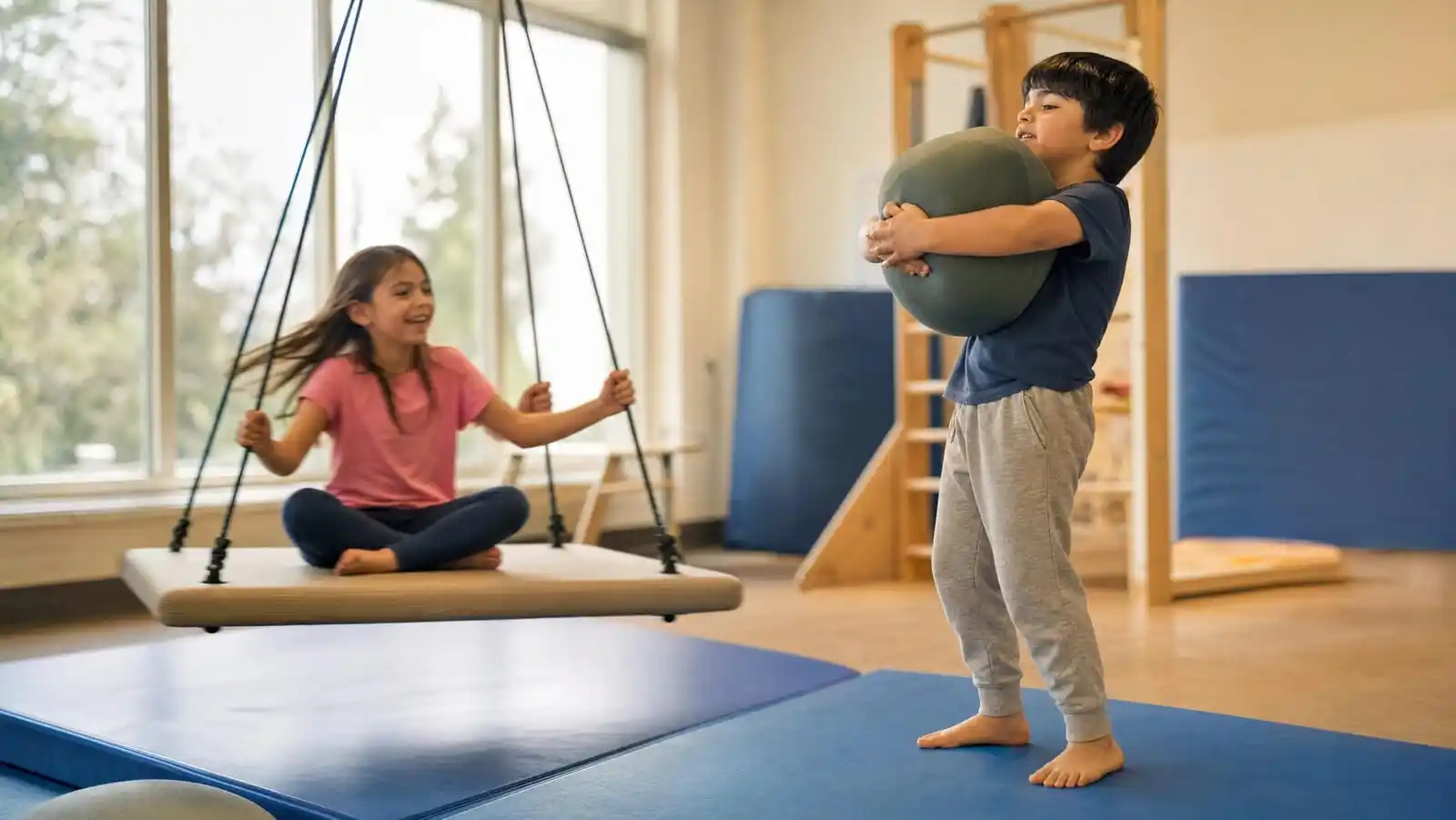
If you own a large exercise ball, rolling it slowly over the back, bottom and legs does the same job — two or three passes, never over head, neck or spine. The ball makes it easy to apply far more than you intend, so start lighter than feels useful.
Palm and Foot Presses
Sit facing each other, press your palms flat against your child's palms and push into each other with even resistance for ten to fifteen seconds, then release. Repeat with the soles of the feet. Quiet, works in a waiting room, and an older kid who has decided hugs are embarrassing will usually still do it.
The Blanket Burrito
Your child lies along one edge of a blanket and you roll them up snugly with the head always out and the face always clear. Firm pats down the length of the roll, then unroll. Children who take to this one often start asking for it by name.
Wall Push-Ups and the Couch Push
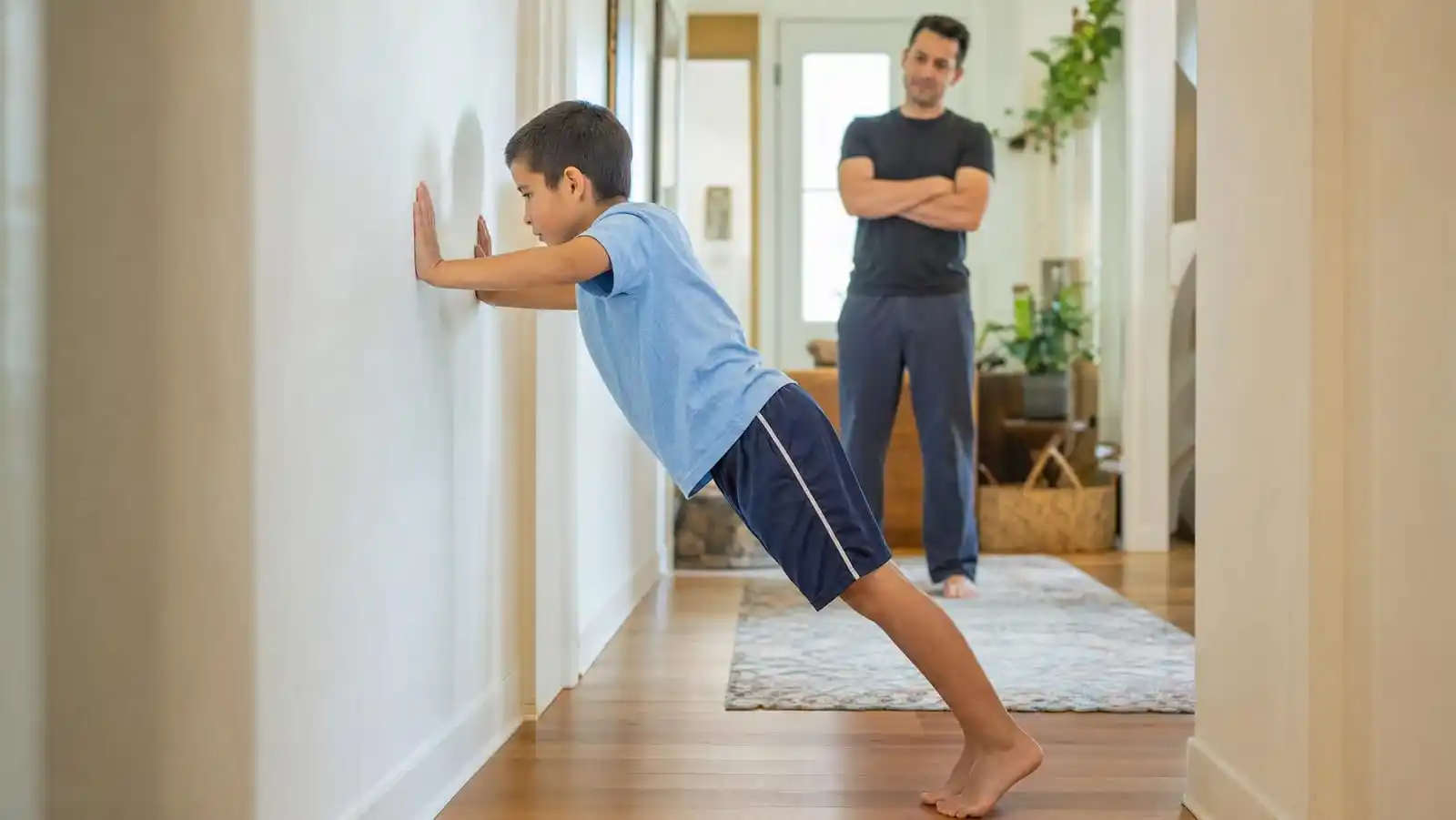
Palms flat on the wall at shoulder height, feet an arm's length back, bend the elbows until the nose is near the wall, then push away — ten slow reps. Or sit on the floor, back against the couch, feet planted, pushing as if to shove it through the wall for a count of ten. Neither needs a second person, and a self-conscious ten-year-old can do them in a school hallway unnoticed.
Joint Compressions: Ask Your OT to Teach You
You will find step-by-step joint-compression tutorials online. We are deliberately not writing one. Chicago Occupational Therapy describes them as "deep pressure applied by the hands to various joints throughout the body," and says they "should ALWAYS be applied by a licensed therapist or a family member that has been trained to do them by a licensed therapist." Ask for a demonstration at your next session.
Tool-Based Deep Pressure: What Each One Is For
Equipment does one thing the free techniques cannot: it delivers pressure without you in the room. Buy accordingly.
| Tool | Best at | Main limitation | |---|---|---| | Weighted blanket | Stationary wind-down, sofa time, bedtime | Strict sizing rules; the sleep evidence is weak | | Weighted lap pad | Sitting still — homework, meals, the car | Covers the legs only | | Compression vest or shirt | Portable pressure at school or out of the house | Fit is everything; must come off on request | | Body sock | Whole-body pressure the child generates alone | Constant supervision; never for sleep | | Resistance bands | Cheap, active pressure through arms and legs | Snap-back risk; needs an adult nearby |
Weighted blankets and lap pads suit the sitting-still parts of the day — but be clear-eyed. A phase III randomized controlled trial of 67 autistic children with severe sleep problems, published in Pediatrics, found a weighted blanket did not increase total sleep time, speed up falling asleep or reduce night waking versus an identical-looking control blanket — though children and parents clearly preferred it, and the researchers reported the blankets were well tolerated over the trial period. Preference is a legitimate reason to use something; guaranteed sleep is not a promise anyone should make you. Our round-up of weighted blankets covers sizing, and one slots into a bedtime sensory routine.
Compression vests and clothing travel — school, supermarket, dentist. Evidence is thin here too: a study of nine autistic children wearing compression shirts and pants during therapy sessions, published in Frontiers in Psychology, found "no significant difference between the treatment and control conditions for repetitive behaviors," and none for off-task behaviour. Fit is the make-or-break, covered in our guide to weighted and compression vests.
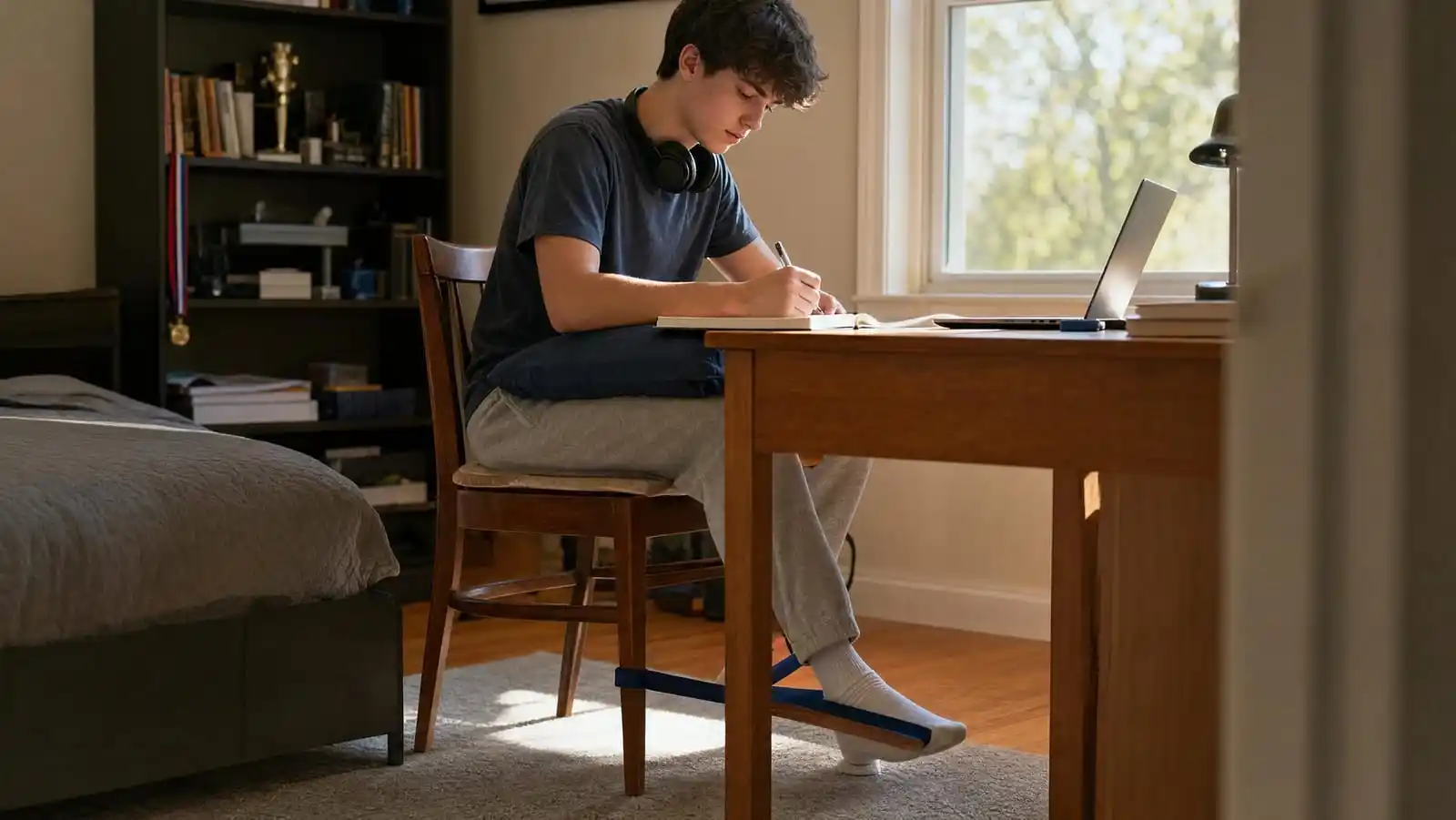
Body socks are a stretchy sack the child climbs into and pushes against, so the pressure is self-generated and self-limiting — far more acceptable to many kids than being squeezed. Constant supervision, never for sleep, face always clear; see body socks and sensory sacks for sizing. Resistance bands are cheapest of all: looped round chair legs, or stretched between two hands.
How Long, How Often, and When
There is no dose, and anyone handing you one in minutes-per-day is guessing. What we can point to is Grandin's own account: "5 minutes of sustained use of the squeeze machine is the minimum typically required to obtain a readily detectable calming effect," and, for her, "using the machine for 15 minutes would reduce my anxiety for up to 45-60 minutes." One person, one device — not a prescription, but a useful shape for expectations. Effects tend to build over minutes rather than landing instantly, and can outlast the activity.
Occupational therapists commonly suggest short, repeated bouts through the day rather than one long session. The best moments in most households:
- Before a hard transition — leaving the house, getting in the car, walking into school
- Before sustained sitting — homework, mealtimes, a long appointment
- Straight after school, when a child who held it together all day comes apart
- During recovery from dysregulation, once the peak has passed — see proprioceptive input for calming and self-regulation for timing this without making things worse
- Bedtime wind-down, as the last step before lights out
Two focused minutes at the right moment beats twenty at the wrong one. Keep a rough note for a fortnight; your own data beats any article, including this one.
Deep Pressure Safety: What Never to Do
Please read this before trying anything above.
- Never apply pressure to the head, neck, throat, spine or stomach, and never bend a joint against its range. Limbs, back, shoulders and hands only.
- Firm is not hard. If it hurts, if your child braces, or if you are using body weight to hold them in place, stop. It should never leave marks or next-day soreness.
- The child must be able to signal "stop" — and you stop instantly. Never apply pressure to a child who cannot independently remove themselves or push the item off, including a sleeping child.
- Never use it as a restraint, a punishment or a compliance tool. Griffin's line is worth memorising: touch pressure "is not a restraint." A child who resists is telling you something.
- Weighted products carry documented, fatal risks. In December 2022 the U.S. Consumer Product Safety Commission and Target recalled about 204,000 children's Pillowfort weighted blankets after children could become entrapped by unzipping the cover and climbing inside; a 4-year-old girl and a 6-year-old girl died of asphyxia. Suffocation and entrapment are not theoretical risks.
- Follow weighted-blanket sizing rules exactly. Brown University Health advises a blanket "should weigh no more than 10 percent of a child's body weight," that you should "never use a weighted blanket on a child younger than age two," that "a child should be able to remove himself or herself from the blanket without being restricted or restrained," and that use "should be discussed with a licensed occupational therapist." Never over the head or face, never in a crib or with infants, and for defined periods rather than left on indefinitely.
- Check with a pediatrician or OT first if your child has low muscle tone, joint hypermobility, fragile bones, a respiratory or cardiac condition, epilepsy, reflux, or any condition affecting breathing, bones, joints or circulation.
- Supervise throughout. Every technique, every tool, every time.
When to Bring in an Occupational Therapist
Deep pressure at home is a support strategy, not a treatment plan. Bring in a pediatric OT when regulation difficulties are affecting daily life; when your child either seeks intense pressure constantly or flinches from ordinary touch; when you want joint compressions or a structured sensory diet, both of which should be taught rather than improvised; or when you are considering a weighted product, which Brown University Health advises discussing with a licensed OT first.
An OT can also tell you what to keep as your child grows, because none of this expires at twelve — see deep pressure and heavy work for teens and adults. The AAP's framing suits the whole project: agree on specific goals, set a trial period, evaluate honestly.
Frequently Asked Questions
How often can we do deep pressure?
As often as your child asks, within reason; there is no evidence-based limit on hugs and cushion squishes. There is no evidence-based number, but many families settle on a few short sessions a day, anchored to predictable moments. Weighted products are different — defined periods, with an OT's input, not all day.
How long before it works?
Grandin's account suggests roughly five minutes of sustained pressure as a practical minimum, with effects that can outlast the session. Some children settle in under a minute; some do not respond at all, which is information rather than failure. Give a new technique a fortnight of calm-moment practice before judging it.
Can I do this without buying anything?
Yes, and we would argue you should start there. Your arms, a couch cushion, a blanket and a wall cover every technique above. Equipment buys portability and hands-free pressure, not better pressure.
Is a weighted blanket safe for my child?
It depends on their age, their weight, and whether they can get out from under it unaided. Brown University Health advises no weighted blankets under age two, no more than 10 percent of body weight, a child who can remove it independently, and a conversation with a licensed OT first.
What if my child hates being squeezed?
Believe them, and stop. Then try the versions where they control the pressure themselves — palm presses, wall push-ups, a body sock, pushing against the couch. Plenty of children who refuse to be squeezed by an adult happily generate the same input on their own terms. And check whether the problem is the pressure or the approach: unexpected touch is alerting, so ask first.
Where to Go From Here
Tonight, try one thing. Ask if your child wants a squeeze, count to ten out loud, and let go. That is the entire intervention, and if they ask for another, you have learned something no article could have told you.
Then build a small routine around the moments already hard in your house, and give it two weeks. If you want equipment after that, our guide to proprioceptive and heavy work sensory tools covers what is worth buying — but the free version really does come first.