This article contains affiliate links. We may earn a commission if you make a purchase through our links, at no extra cost to you.
Key Takeaways
- Sensory differences do not disappear with age. Research on autistic adults finds they continue into adulthood.
- The input is identical to childhood heavy work — pushing, pulling, lifting, carrying, squeezing. Only the delivery changes.
- Dignity is the design constraint. Nobody keeps using a tool that marks them out.
- Most adult sensory tools are ordinary life: a loaded backpack, a gym session, a dog walk, a heavy blanket.
- Self-knowledge outlasts equipment. Knowing your pattern, then asking for what you need, is the skill that lasts.
Proprioceptive input for adults is the same muscle-and-joint feedback that settles a restless six-year-old — pushing, pulling, lifting, carrying, squeezing — delivered in a form that fits a grown-up life. Sensory needs do not vanish at puberty. They mature. What changes is not the nervous system's appetite but the packaging: a weighted lap pad instead of a weighted teddy, a rowing machine instead of a crash mat.
If you are reading this for yourself, you may already have a private catalogue of things that help and no vocabulary for why. If you are reading it for a teenager who has outgrown the sensory cupboard, the answer is rarely a bigger version of the same product. Our explainer on proprioceptive and heavy work sensory tools covers the mechanics; this piece is about using them at thirteen, or fifty.
Sensory Needs Don't End at Childhood — They Stop Being Written About
Almost every article about sensory processing is written for the parent of a young child. That is a publishing pattern, not a biological one.
A study of sensory processing and community participation reports that sensory processing differences are common in autistic adults, "with prevalence rates ranging from 77 to 95%," and concludes that they "continue into adulthood and may influence how individuals engage with their environments" (PMC).
The gap is explicit. A co-produced study of 49 autistic adults in the Journal of Autism and Developmental Disorders opens by noting that "despite evidence suggesting that sensory reactivity differences persist into adulthood... the sensory experiences of autistic adults have been under-represented in research" (MacLennan et al., PMC). That study also found 41.4% still engaged in "a diverse range of seeking behaviours."
If the information thinned out sharply after age twelve, you were not imagining it.
What Proprioceptive Seeking Looks Like in a Teen or Adult
Grown-up seeking is less visible than a child crashing into a sofa, but not subtle once you know its shape. You might recognise some of these in yourself:
- Cracking knuckles, neck and back through the day
- Bouncing a leg under the desk, or pressing your feet into the floor in meetings
- Giving and asking for very tight hugs — the kind other people find too firm
- Sleeping under a pile of covers, even in summer, or wedged against a wall
- Gravitating to the gym, climbing or manual work and feeling better after
- Chewing pen lids, straws, ice, gum, or the inside of your cheek
- Pacing on the phone or while thinking
- Preferring tight clothing — compression sleeves, firm waistbands, a jacket kept on
Recognising yourself in a list is not a diagnosis, and nothing here suggests you need one.
One detail is worth holding onto: those adults reported that when they were in control of the intensity, sensory experiences became "tolerable or enjoyable" (MacLennan et al., PMC). Control is not a nice-to-have here. It is most of the strategy.
The Dignity Problem: Why Childhood Tools Stop Working
Ask a fifteen-year-old to wear a weighted vest to school and you will usually get a flat no. That refusal is not stubbornness. It is an accurate risk assessment.
Childhood sensory equipment is designed to be seen — by a parent checking it is on, by a teaching assistant, by a therapist across the room. Visibility is a feature at six and a liability at sixteen. Add primary colours and toddler-facing packaging, and the message is that the tool belongs to someone younger.
"Discreet" is specific, not a vague preference. It means the tool looks like ordinary clothing, office kit or sports equipment; goes on and off without an audience; works while you do something else; and needs no explanation. A tool that fails those tests ends up in a drawer no matter how well it works.
Everyday Heavy Work That Doesn't Look Like Therapy
Adults have far better access to proprioceptive input than children do, and most of it is ordinary life.
| Type of input | What it looks like at 15, 25 or 45 | |---|---| | Load-bearing | Groceries in one trip, moving furniture, hauling firewood, a loaded backpack | | Resistance | Strength training, resistance bands, hand grippers, gardening, kneading dough | | Whole-body effort | Climbing, swimming, rowing, hiking with a pack, martial arts, cycling uphill | | Sustained hold | Yoga, planks, wall sits, carrying a sleeping toddler | | Rhythmic work | Walking a dog that pulls, sweeping, shovelling snow |
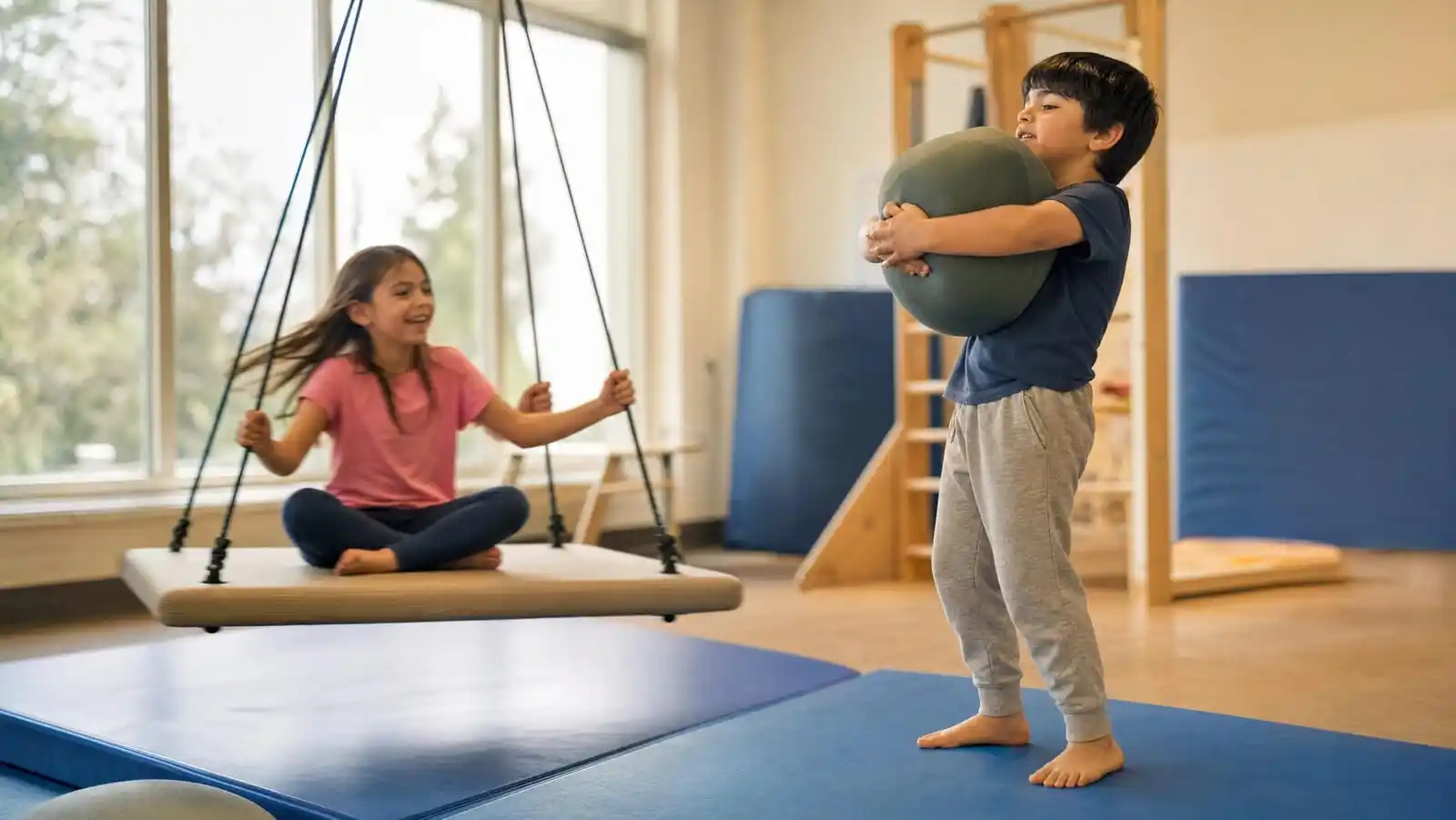
Most of this is the childhood list grown up — our round-up of heavy work activities for kids is the same principle at a smaller scale. Climbing, rowing and swimming add movement input on top of muscle work; how proprioceptive and vestibular input differ explains why a rowing session and a spin class do not leave the body in the same state, and vestibular tools for teens and adults covers that side.
The effort may pay off cognitively too. Research on adults with ADHD has examined the acute effects of aerobic exercise on executive function and attention, with a single session producing improvements on some measures (PMC).
Treat this as the main event, not a consolation prize. A weighted lap pad is a good tool. A Saturday spent moving soil is a better one.
Discreet Tools for the Rest of the Day
You cannot climb during a two-hour meeting. These fill the gaps without announcing themselves.
- Compression base layers. Compression tops, leggings and cycling shorts under normal clothes give steady all-over pressure and read as sportswear — the adult answer to what a vest does for a child. Our guide to weighted and compression vests is written for children; older users generally prefer compression clothing or a lap pad.
- A weighted lap pad. Invisible under a desk, easy to remove.
- A weighted blanket at night. A randomised controlled study of 120 adults with insomnia and a co-occurring psychiatric diagnosis found weighted chain blankets to be an effective and safe intervention for insomnia in that group (Ekholm et al., Journal of Clinical Sleep Medicine). If sleep is the pressure point, teen sleep and sensory processing goes deeper.
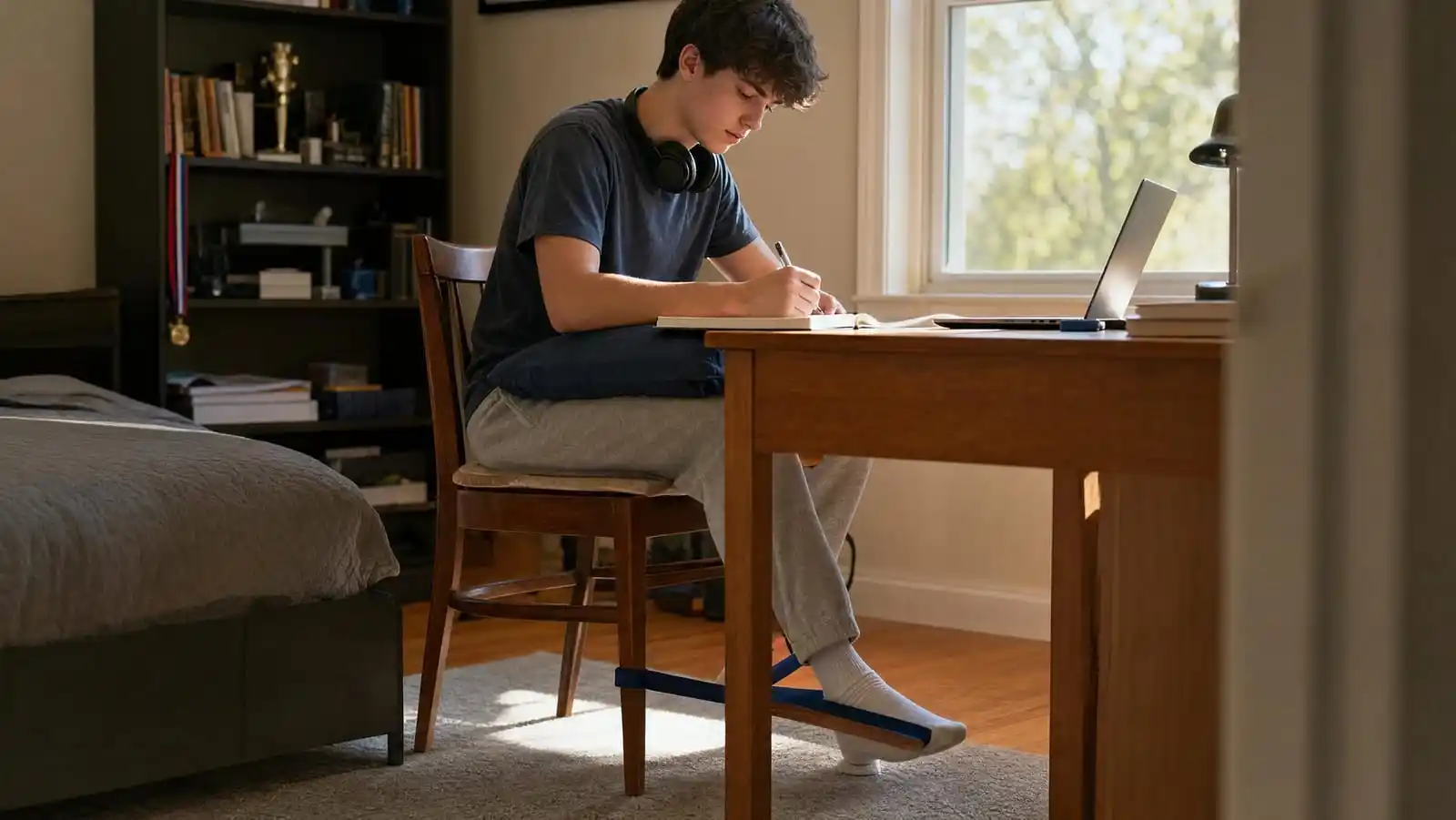
- Resistance bands and hand grippers. A loop band round the chair legs, or a gripper in a pocket, delivers real muscle work in thirty seconds.
- A weighted backpack. For a commute or a lap of the building — the most invisible heavy-work tool there is.
- Adult-appropriate fidgets. Metal, wood, leather, plain rubber: objects that pass as desk items or jewellery. See fidget tools for adults with ADHD, and for chewing, oral sensory tools for teens and adults.
Why Pressure May Settle the System
In a study of 50 adults wearing a deep-pressure vest, researchers recorded decreased sympathetic nervous system activity alongside increased parasympathetic activation, concluding that deep pressure can alter autonomic nervous system functioning (American Journal of Occupational Therapy). One small study is not proof for any individual, but it matches what many report.
Getting Input Through a Timetabled Day
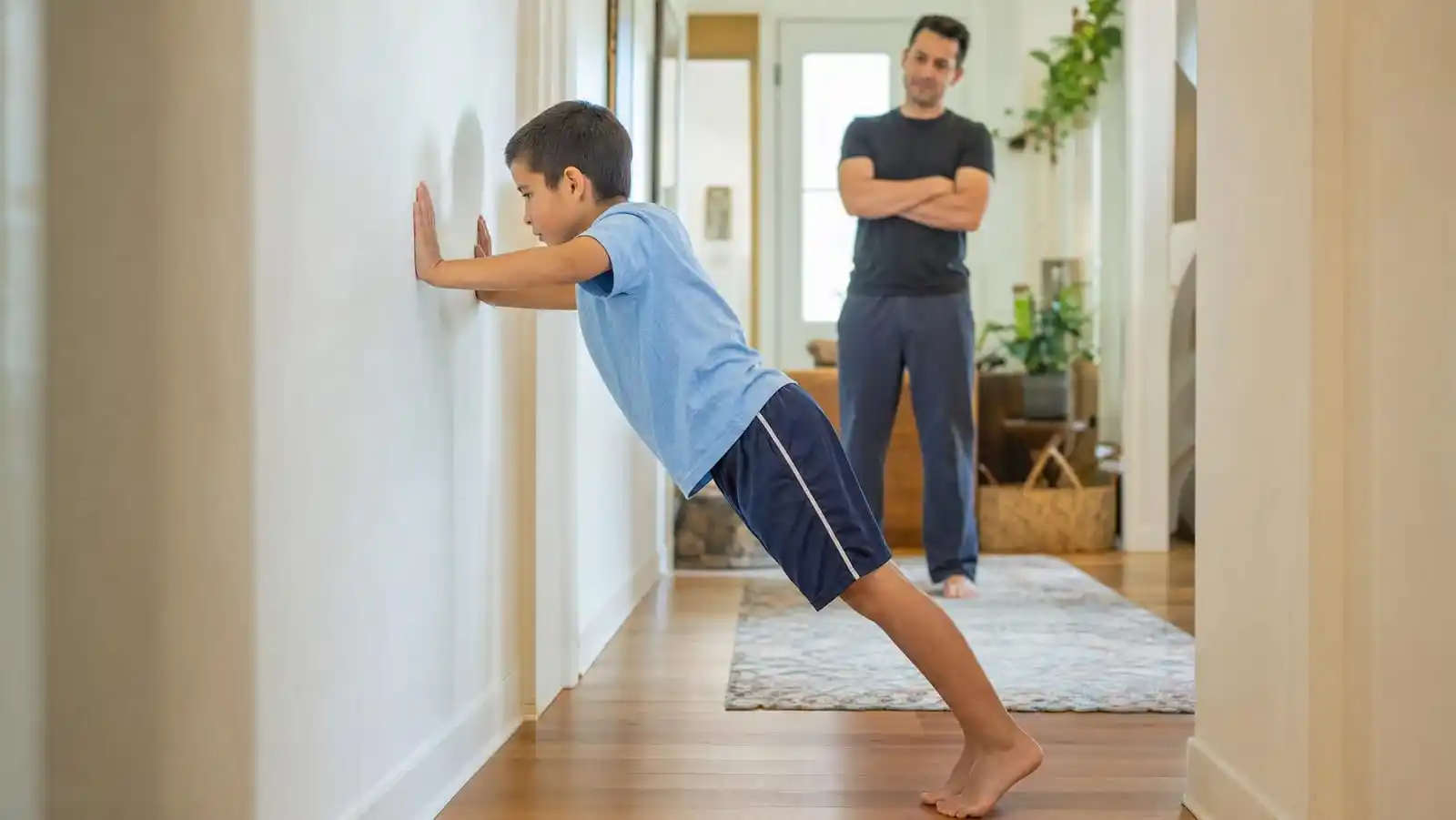
School is the hardest environment, because someone else schedules the movement. What works is structural rather than clever: walk the long way between classes carrying the bag rather than wheeling it; take a job with weight in it — moving chairs, setting up the hall, shelving library books; do wall pushes before a difficult lesson; keep an agreed chew or fidget; and anchor in the seat, feet pressing down, hands pushing into the chair edge.
Agreement matters more than equipment. A tool a teen has to defend every lesson gets abandoned; one the school signed off on gets used. Where a plan exists — an IEP, a 504, an EHCP — sensory strategies can be written into it explicitly.
For adults around a desk job or shift work, the logic is front-load and bookend: real effort before work and after it does more than anything available at a keyboard. In between, take the stairs, carry things, park further away, stand on calls. The Job Accommodation Network, a free service fully funded by the US Department of Labor's Office of Disability Employment Policy, catalogues workplace adjustments relevant to autistic employees, from noise-cancelling earbuds to lighting changes — and you need not disclose a diagnosis to ask for a standing desk or a quieter corner.
Building Your Own Sensory Profile
This is the part that outlasts every product above: the shift from someone manages my sensory needs to I know what I need and I ask for it.
Start by tracking, not fixing. For two weeks, note the moments your body demanded something — the leg bouncing in one specific meeting, the need to lie under something heavy on a Friday night, the walk that made an unbearable afternoon survivable. You are looking for the pattern, not a verdict.
Then map it against four questions:
- What input do I go looking for? Pressure, movement, chewing, texture, or some mix.
- What input do I flee? The other half of a profile, and often the more expensive half.
- When does the need spike? Before demands, after them, at transitions, at the end of a long day of masking.
- What is the smallest version that works? Because that is the one you will actually use on a Tuesday.
There is a formal version. The Adolescent/Adult Sensory Profile is a self-report questionnaire for ages 11 and up, built on Dunn's model of sensory processing (Pearson Assessments). That model sorts responses into four quadrants — low registration, sensory seeking, sensory sensitivity and sensory avoiding (Dunn's Model of Sensory Processing, PMC). Pearson restricts the questionnaire itself to qualified professionals, but the four-quadrant model behind it is a useful thinking tool even informally.
Self-advocacy is explicitly part of what occupational therapy is meant to build: the American Occupational Therapy Association describes practitioners as prioritising "individual self-determination and the right to choice and control to encourage development of self-advocacy skills" (AOTA). In practice it is mostly short, unembarrassed sentences. I think better moving, so I'll stand for this bit. I'm not fidgeting at you — it's how I listen.
For Parents of a Teen
The handover is the goal: stop managing the sensory diet and start narrating it — "you always seem steadier after you've been climbing" — then hand over the choosing.
Using Weight, Compression and Resistance Safely
Older bodies handle more load than children's, which makes it easier to overdo.
- Size weighted items sensibly, never to the point of pain or restricted breathing. Heavier is not better; the point is steady pressure, not strain.
- Never use weighted or compression items on anyone who cannot remove them independently, or who cannot communicate that they want them off.
- Talk to a doctor or physiotherapist before starting strength or resistance work — particularly with joint hypermobility (including hEDS), joint instability, low muscle tone, or any cardiac, respiratory or spinal condition, and during pregnancy. A large cross-sectional study of adults found a significant association between autism and generalised joint hypermobility (PMC), and hypermobile joints change what safe loading looks like.
- Stop anything that causes pain, numbness, tingling or joint strain. This should feel grounding, never like a fight.
- Get programming from someone qualified. Sets, reps and loads are outside what an article can responsibly offer; ask a physiotherapist or a coach experienced with neurodivergent clients.
- For a teen using equipment at school, agree it in advance with the school and ideally an OT.
When to Look for an OT Who Works With Adults
Sensory-focused occupational therapy has grown up largely around children, which can make adult-focused OTs harder to find — but they exist. The AOTA describes the profession's remit as covering "self-regulation and sensory needs, adaptive skills, motor development, mental health, social participation, and daily life skills," alongside work readiness (AOTA).
Seek one out if sensory needs are affecting your work, sleep, relationships or ability to leave the house. Search terms like adult sensory occupational therapy or neuro-affirming occupational therapy tend to surface the right practices; then ask whether they see adults and use adult sensory measures. Adult neurodevelopmental clinics and vocational rehabilitation services are also worth trying.
None of this requires a diagnosis. Formal assessment is a process undertaken with a qualified clinician, while many adults reach an understanding of themselves without one; researchers have examined why some autistic adults lack a clinical diagnosis and why that matters for inclusion (Autism, PubMed). Both routes are legitimate.
Frequently Asked Questions
Do sensory needs go away as you get older?
Current evidence says no. A study of autistic adults reported sensory processing differences at rates "ranging from 77 to 95%" and concluded that they "continue into adulthood" (PMC). What changes is visibility: adults build routines and homes around their needs, so the need looks smaller than it is.
Is heavy work the same thing as stimming?
They overlap without being identical. The National Autistic Society defines stimming as "self-stimulating behaviour" that can also be described as "self-regulating" behaviour, serving purposes including staying calm and sensory enjoyment (National Autistic Society). Heavy work delivers muscle-and-joint input deliberately; some stims deliver similar input spontaneously. The NAS position on suppression is blunt: "if stimming is harmless, there is no reason to prevent an autistic person from doing it."
Is going to the gym really a sensory strategy?
For a lot of people, yes — resistance training is close to a pure delivery system for proprioceptive input, and in one small study of adults with ADHD, a single 30-minute session of moderate cycling was followed by faster and more consistent reaction times on an attention task (PMC). The caveat: gyms are sensory environments in their own right — fluorescent light, mirrors, music, strangers. Home equipment or outdoor work may suit you better.
Can adults get an occupational therapy assessment?
Yes, though adult-focused sensory OTs are less common than paediatric ones. Occupational therapy's remit explicitly includes adults (AOTA), and self-report measures such as the Adolescent/Adult Sensory Profile are designed for ages 11 and up (Pearson Assessments).
The Takeaway
Nothing fundamental separates what you need now from what you needed at six: input that tells your body where it is and what it is doing. What is new is authority. You decide when, how much, and in front of whom.
Start with what already works. Almost everyone reading this has a version of the walk, the hug, the heavy blanket, the shift that leaves them tired but level. Name those, do them on purpose, and add discreet options for the hours you cannot get away. For the full picture, Sensory Toy Space's heavy work sensory guide is where the series starts — and if texture rather than pressure is your thing, see tactile tools for teens and adults.
You are not too old for this, and you never were.