This article contains affiliate links. We may earn a commission if you make a purchase through our links, at no extra cost to you.
Key Takeaways
- Proprioceptive input at school means short bursts of heavy work — pushing, pulling, carrying, lifting — that fit a class period with no equipment and no extra staffing.
- Discreet beats dramatic. A desk press or a book-crate delivery can give a 10-year-old similar muscle-and-joint feedback to animal walks, without the social cost.
- The best classroom heavy work is a job the teacher already needs done, so it subtracts from the to-do list rather than adding to it.
- Whole-class movement is the safest default — nobody gets singled out.
- The evidence is mixed. Whole-class movement breaks have some support; alternative seating and weighted vests for classroom attention largely do not.
Proprioceptive input activities at school are short bursts of heavy work — pushing, pulling, carrying, lifting — built into the ordinary school day so a student's muscles and joints get strong feedback without leaving the room or drawing attention. Chair push-ups before writing. Books delivered to the office. The whole class pressing palms together before a test.
That is the easy part. The hard part is that a classroom is not a living room: twenty-five other children, one adult with no spare hands, a bell schedule that ignores anyone's nervous system, and a fifth grader who would rather fail the quiz than crab-walk in front of peers.
This guide is for both parents and teachers, and we flag which parts are which. For the theory, see our complete guide to heavy work and proprioceptive input. Everything below assumes you already believe heavy work helps and need it to survive a real classroom.
What Counts as Proprioceptive Input at School?
Proprioceptive input is the feedback the brain gets from muscles, tendons, and joints working against resistance. At school, that means anything with weight, resistance, or effort behind it: walking to the pencil sharpener is movement; carrying the class dictionaries there is heavy work.
Four categories fit a school day:
- Push and pull — desk presses, chair push-ups, a loaded cart, a heavy hallway door
- Carry and lift — book crates, lunch tubs, gym equipment, a loaded backpack
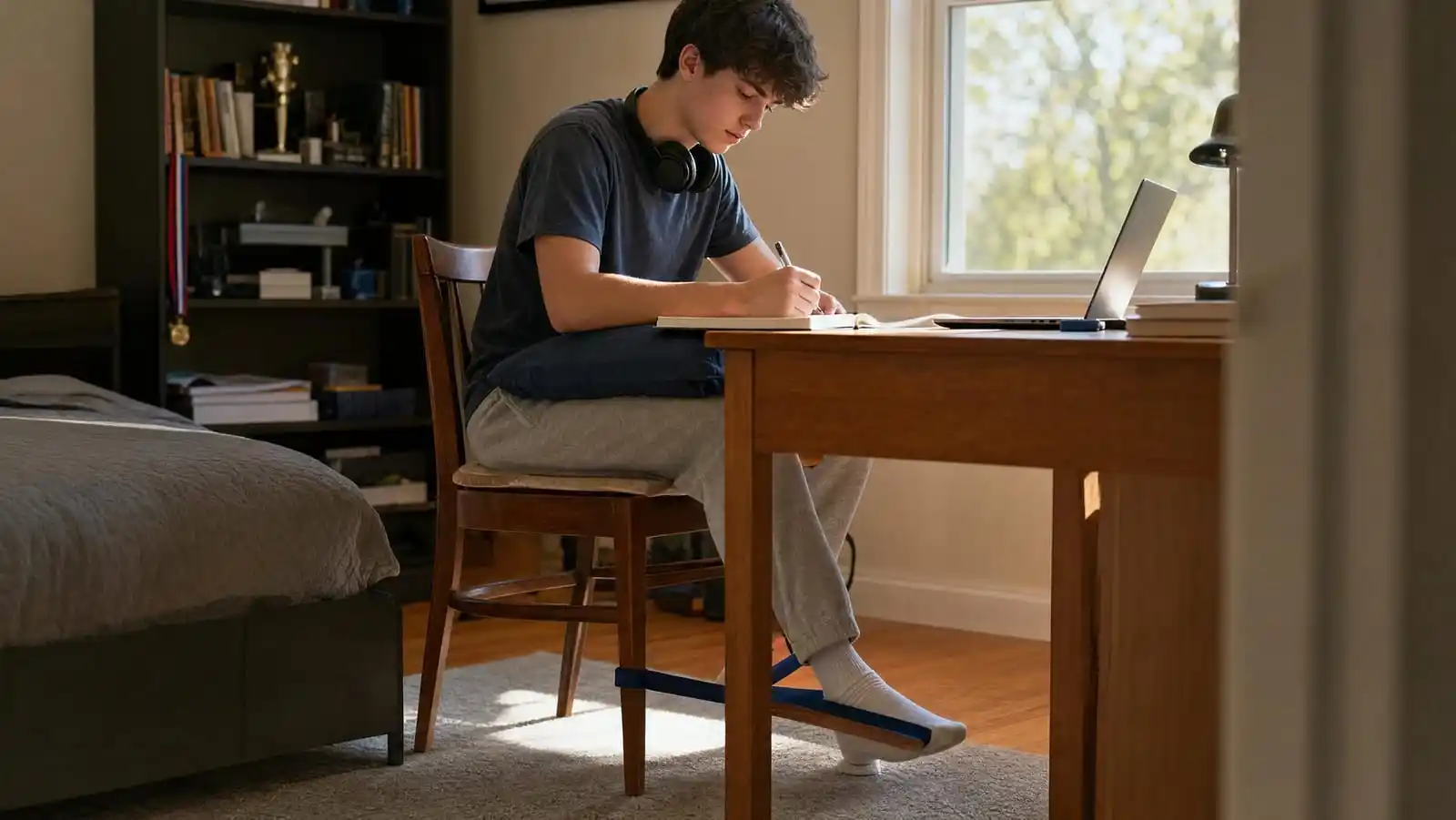
- Resist — wall sits, palm presses, chair squats, feet pressed into a band across the chair legs
- Compression — a firm self-hug, a lap pad, a snug hoodie pulled tight
The OT Toolbox's classroom heavy work guide suggests embedding these into existing routines — passing out materials, rearranging desks, wiping tables — rather than bolting on a separate "sensory time."
Why the Classroom Is a Different Problem Than Home
At home you can improvise: hallway wheelbarrow walks, a crash pad, twenty minutes on the trampoline. A classroom removes nearly all of it. Five constraints shape what follows.
- Supervision math. One adult, twenty-five-plus children. Nothing can require the teacher to leave the group.
- Social visibility. By roughly third grade, children track what peers notice. A strategy that costs social standing gets refused — and refusal reads as defiance.
- Fixed schedules. Regulation needs ignore the bell, so the plan must attach to existing transitions.
- Space and safety. Equipment in a walkway is a trip hazard; anything near a doorway is a fire-code problem.
- Policy. Districts have rules about equipment from home, especially weighted items.
Home still matters — the same child benefits from heavy work activities you can do at home before school and after pickup. The school version just has to be smaller, quieter, faster.
Discreet At-Desk Heavy Work Nobody Has to Notice
These are the workhorses: silent, under a minute, no equipment, invisible two seats away.
| Activity | How to do it | Best moment | |---|---|---| | Chair push-ups | Hands on the seat edge, press down, lift off 5 seconds. Five reps. | Before writing tasks | | Desk press and lift | Palms flat, push down 10 seconds; hands underneath, pull up 10 seconds. | Mid-lesson, seated | | Palm press | Palms together at chest height, elbows out, 10 seconds. | Anywhere, incl. assemblies | | Chair squats | Stand and sit slowly five times, no hands. | Transitions | | Wall sit | Back to wall, knees at 90 degrees, hold. | Hallway, line-up | | Foot press | Push both feet into the floor, or a band across the chair legs. | During instruction |
Understood.org's classroom accommodations for sensory processing challenges includes the resistance-band idea, with the sensible caveat to consult the occupational therapist before rigging anything to furniture.
For teachers: teach the class two or three of these once, in September, as "brain resets." For parents: practice them at home first — a strategy that needs an adult cue will not happen on a busy Tuesday.
Heavy Work Built Into Transitions You Already Have
Transitions are free real estate: they already involve movement, and nobody looks strange moving during them.
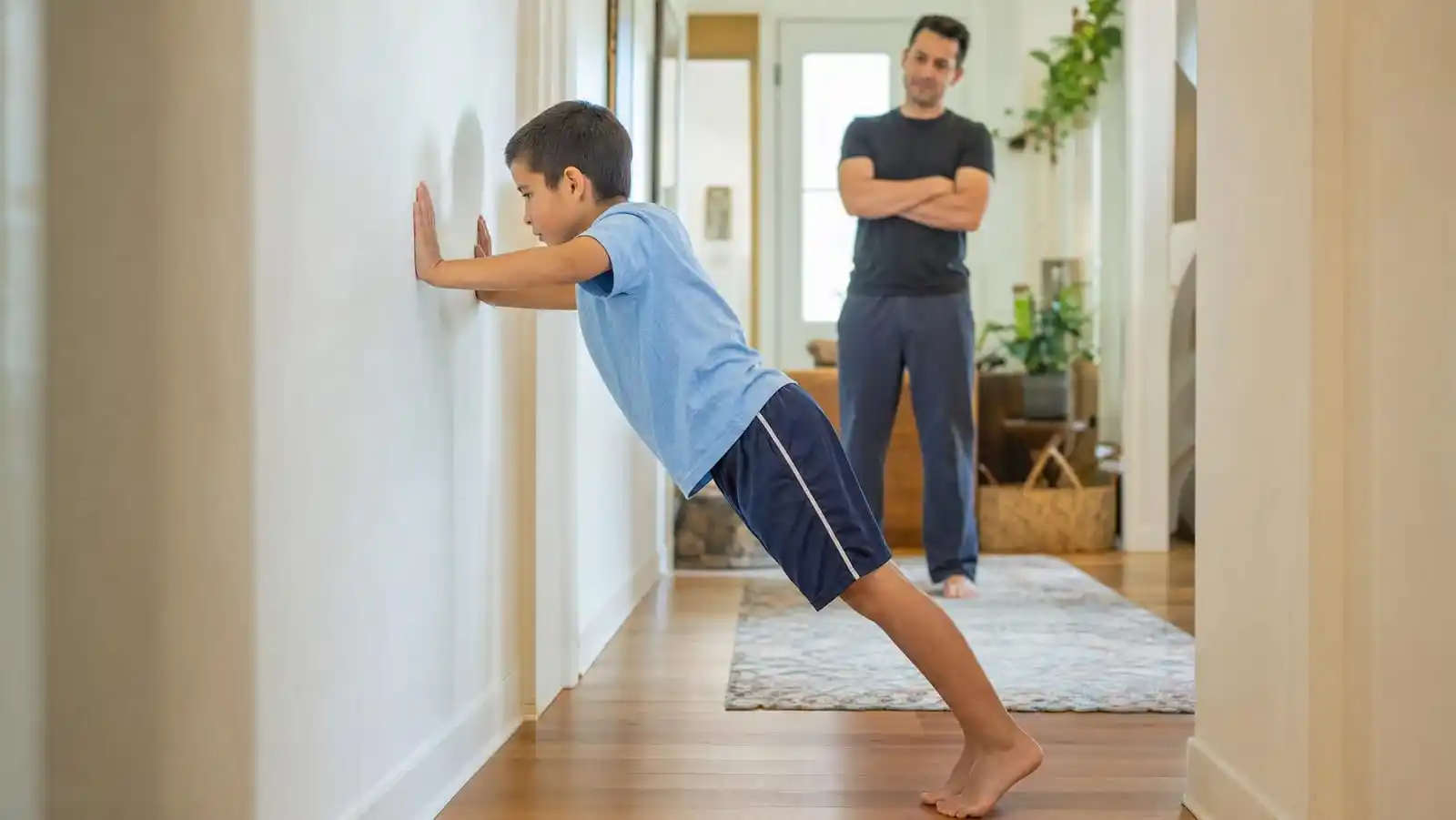
- Line-up presses — the whole line does five wall pushes before the hallway
- Chair stacking at the end of the day, two at a time
- Desk rearrangement for group work, done by students
- Crate carrying — books, laptops, or lunch bags to the next room
- Door duty — one student holds the heavy hallway door for everyone
- Backpack march — for older students, a loaded backpack between classes looks like nothing at all
The child gets input on the way to what they were already doing.
Classroom Jobs That Are Actually Useful to You
For teachers: the heavy work a child needs is mostly work you need done anyway.
- Stacking chairs, or pushing in every chair in the room
- Carrying the recycling bin to the hall, or a box of copies to the office
- Wiping tables with a spray bottle (the squeeze is resistance work for the hands)
- Erasing a whiteboard with big, firm arm strokes
- Hauling PE equipment out and back, or re-shelving the class library
The OT Toolbox's classroom guide lists nearly this set of "heavy jobs," including carrying library books and lunch crates. Rotate them so they read as privileges, not accommodations.
For Teachers: The 30-Second Version
If you change one thing, make it this: give the student who crashes, leans, and slides out of their chair a two-minute delivery errand right before the hardest academic block. It costs nothing, it is invisible as an accommodation, and it removes a box from your desk.
Whole-Class Options So No Child Is Singled Out
Whole-class movement solves the visibility problem outright, and there is decent evidence it helps everyone. The Community Preventive Services Task Force recommends classroom-based physical activity break interventions for primary school students, delivered by trained classroom teachers. Its review also reported a median increase of roughly 26 minutes in time students spent attentive to lessons after activity breaks — though that rests on two studies, and the Task Force flags academic outcomes as an evidence gap.
Formats worth trying:
- Sixty-second reset — ten chair squats, ten desk presses, ten shoulder shrugs
- Isometric round — palm press, wall push, self-hug, ten seconds each
- Heavy-work clean-up — everyone stacks, pushes in, and carries at once
- Deskercise before assessments — a fixed pre-test routine the room knows
No permission slip needed; it is simply how the room runs.
Wearables, Preschoolers, and Combining Supports
For students who need input during work, wearables can help — and this is where professional input matters most. Weighted and compression vests sit under a hoodie unseen; lap pads stay on the desk. The OT Toolbox's review of weighted vests and compression garments reports conflicting findings: one systematic review found moderate evidence that weighted items can increase attention, while an American Journal of Occupational Therapy review gave them a "red light" designation. The same resource cites practice guidance of roughly 5 to 10 percent of body weight, wear periods around 20 minutes, and always consulting an OT.
Younger rooms need a different calculus — preschool and kindergarten already build in floor time, carrying, and gross-motor play, so start from our guide to proprioceptive activities for toddlers and preschoolers.
Proprioception also rarely works alone. A 2025 Frontiers in Pediatrics systematic review found moderate evidence that targeting multiple sensory systems can affect functional behaviors — and that alternative seating alone did not improve attention. So pair heavy work with quiet tactile fidgets, or with chew tools for school for students who chew collars and pencils.
How Often, and What to Expect
There is no research-established dose. Many occupational therapists suggest offering input before demanding tasks and at natural transitions rather than waiting for dysregulation, with something brief every 60 to 90 minutes as a common starting pattern — a hypothesis, not a prescription.
Be realistic. Heavy work may help a student settle, sit, and start. It will not fix a curriculum mismatch, an anxiety disorder, or a reading difficulty, and nobody should promise it will raise test scores.
What the Research Actually Says
The evidence base for classroom sensory strategies is mixed and still developing. The American Academy of Pediatrics' 2012 policy statement on sensory integration therapies concluded that sensory-based therapy may be acceptable as one component of a comprehensive plan, but that research on effectiveness is "limited and inconclusive," and advised running defined trials and evaluating whether the strategy is actually working. Treat any classroom plan the same way: a measurable trial, not a fixture.
How to Actually Get This Into Place
For parents: opening the conversation
Lead with the teacher's problem, not your child's diagnosis. "He gets out of his seat during independent work" is a shared problem; "he has proprioceptive seeking behaviors" is homework for the teacher.
A workable script: "At home, giving him something heavy to carry before a hard task helps him settle. Would you be open to trying him as your book-crate person before independent work for two weeks?" That costs nothing, is time-limited, and gives you data. Email it, so there is a dated record.
For teachers: what you can do this week
Pick two whole-class resets and one classroom job rotation. Do not build a sensory diet — that is the OT's job. Observe for two weeks and note what changes.
The school OT's role
Under IDEA, occupational therapy is a related service: the U.S. Department of Education's regulation at 34 CFR 300.34 defines related services as supportive services required to help a child with a disability benefit from special education, and names occupational therapy among them. AOTA describes school-based practitioners as supporting development and learning through collaboration with the education team. In practice that can mean consulting with teachers and working inside the classroom, as well as pulling a student out for individual sessions. If your school has an OT, they are the right person to design and check a heavy work plan.
Where this sits relative to an IEP or 504 plan
Most heavy work needs no paperwork — a classroom job is just good teaching. Formal plans matter when a support must survive a change of teacher. Broadly, in the US:
- An IEP is developed under IDEA for eligible students. The Center for Parent Information and Resources explains that the IEP team decides which related services a child needs, and must specify when they begin, how often and for how long, and where — with changes requiring another meeting.
- A 504 plan comes from Section 504 of the Rehabilitation Act. The Department of Education's FAQ on Section 504 and FAPE explains that FAPE means regular or special education and related aids and services designed to meet a student's needs as adequately as those of students without disabilities, decided after an individualized evaluation.
- Requesting one starts with a written request. Understood.org's walkthrough on getting a 504 plan recommends emailing so it is dated, then following up within about a week.
Specifics vary by state and district, and no school is required to provide any particular sensory tool.
Safety and Practicality: The Non-Negotiables
- Supervision. An adult should be able to see the activity. Errands for young children need a defined route and a known adult at each end.
- No trip hazards, no blocked exits. Bands, mats, crates, and cushions stay out of walkways and away from doorways and fire routes.
- Check school policy first. Districts differ on equipment from home, especially weighted items, and liability matters.
- Weighted tools need professional input. Check with the school OT or nurse first, follow their guidance on weight and duration, and make sure the child can remove the item independently. Joint hypermobility, cardiac or respiratory conditions, recent injury, or seizure disorders also warrant a word with the child's physician.
- Never as punishment, never as a bargaining chip. Heavy work and sensory breaks must not be withheld until work is finished, used as a consequence, or made a condition of participation.
- Never force it. If a child declines a tool, that is information, not defiance.
Frequently Asked Questions
How do I ask my child's teacher for classroom heavy work?
Frame it as a two-week experiment tied to a problem the teacher already sees, and propose something easy — a classroom job before a hard block, or permission to do chair push-ups at the desk. Avoid handing over a printed sensory diet; that lands as extra work.
How often should sensory breaks happen during the school day?
There is no established dose in the research. Many occupational therapists recommend offering input proactively — before demanding tasks and at existing transitions — rather than after dysregulation, with something brief every 60 to 90 minutes as a starting point.
Will other kids notice — and will my child be embarrassed?
They will notice anything that looks like a separate protocol. They will not notice a desk press, a palm squeeze, or a book delivery. That is why we push discreet and whole-class options above roughly third grade. Ask older students what they are willing to do in front of peers.
Does proprioceptive input need to be written into an IEP or 504 plan?
Usually not — most classroom heavy work is ordinary good practice a teacher can adopt informally. A written plan matters when the support must persist across teachers and years, or when informal arrangements keep breaking down. Eligibility is decided by the school team, and details vary by state and district.
What if the school says no?
Ask what the concern is: safety, supervision, equipment, or fairness. Most objections are solvable — whole-class resets sidestep fairness, classroom jobs sidestep supervision, no-equipment options sidestep policy. If a low-cost request is still declined and your child is struggling, ask in writing about an evaluation and contact your state's parent training and information center.
Bringing It Together
Classroom proprioceptive input works when it is small, useful, and invisible: a job the teacher needs done, a reset the whole class does, a desk press nobody sees. It fails when it becomes a separate protocol that costs a child social standing or a teacher a spare hand.
Start with one whole-class reset and one classroom job this week, and loop in the school OT early. For the full picture, see our proprioceptive sensory tools guide.