This article contains affiliate links. We may earn a commission if you make a purchase through our links, at no extra cost to you.
Quick Verdict: Indoor vs Outdoor Sensory Swings
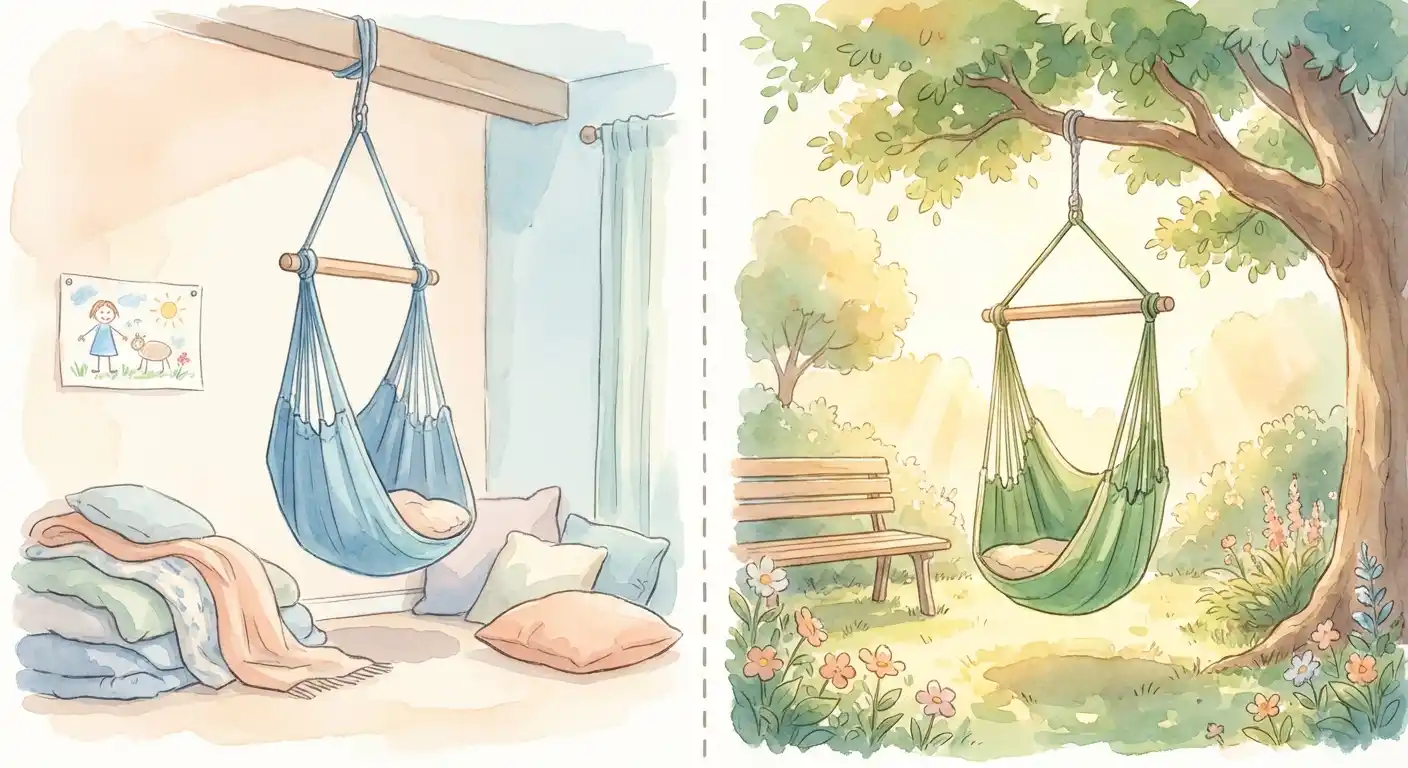
Choose indoor if you want year-round access regardless of weather, need a climate-controlled environment for sensory-sensitive children, live in an apartment or rental, or want easier supervision during therapy sessions.
Choose outdoor if you have a suitable tree or structure, want the added calming benefits of nature and fresh air, need a larger swing arc for more movement, or prefer not to drill into your ceiling.
Best news? Many sensory swings work in both locations. Our top versatile pick is the Harkla Sensory Swing, which includes both ceiling hardware and tree straps. For indoor-only, the DreamGYM Doorway Swing requires no permanent installation.
Why Location Matters for Sensory Swings
The decision between indoor and outdoor sensory swings affects more than just where your child swings. It impacts installation requirements, how often you can use the swing, and which products will work for your situation.
For children with autism, ADHD, or sensory processing differences, consistent access to vestibular input is essential for regulation. A swing that can only be used on sunny days may not provide the daily sensory diet your child needs. Meanwhile, an indoor-only setup might miss the powerful calming benefits of swinging in nature.
In our complete guide to sensory swings and vestibular toys, we cover the therapeutic benefits of swinging in detail. This article focuses specifically on helping you decide where to set up your sensory swing—and which products work best for each location.
We'll break down the pros and cons of indoor versus outdoor placement, explain your installation options, and recommend the best swings for each scenario. If you're also deciding between swing styles, check out our pod vs hammock swing comparison first.
Indoor Sensory Swings: Benefits and Considerations
Pros of Indoor Swings
Year-round access is the biggest advantage of indoor swings. Rain, snow, extreme heat, or freezing temperatures won't interrupt your child's sensory routine. For children who rely on daily swinging for regulation, this consistency is invaluable.
Climate control matters more than many parents realize. Sensory-sensitive children often struggle with temperature extremes, humidity, or wind. An indoor swing provides a controlled environment where your child can focus entirely on the vestibular input without additional sensory challenges.
Easier supervision keeps your child safe while allowing you to multitask. You can watch your child swing while cooking dinner, helping siblings with homework, or working from home. The swing stays within earshot and eyesight.
Privacy for calming gives children a dedicated space for regulation without feeling exposed. Some children feel self-conscious swinging where neighbors might see. An indoor swing in a bedroom or sensory corner becomes their personal retreat.
Fabric longevity increases dramatically when swings stay indoors. UV rays, rain, and temperature fluctuations degrade fabric over time. Indoor swings often last years longer than outdoor-exposed swings.
Cons of Indoor Swings
Installation requirements vary but always exist. You'll need to mount something—whether drilling into a ceiling joist, setting up a doorway bar, or assembling a freestanding frame. Apartments and rentals may restrict permanent modifications.
Limited swing space constrains movement. Indoor swings typically have shorter arcs due to ceiling height and room dimensions. Children who crave big, sweeping movements may feel restricted.
Room footprint becomes a factor, especially for stand-based systems that need roughly 8x8 feet of floor space. In smaller homes, dedicating this space to a swing means sacrificing other uses. For budget-friendly setup ideas, see our guide to creating a sensory room with swings on a budget.
Indoor Installation Options
Ceiling Mount: The most secure option provides 360-degree rotation capability when paired with a swivel hanger. You'll need to locate a ceiling joist (stud finder required) and drill into solid wood. Weight capacity depends on your ceiling structure, but most residential joists support 200-300+ pounds when properly installed. This option gives the most "swing feel" indoors but requires permanent modification.
Doorway Bar: Perfect for apartments and rentals since it requires no drilling. Tension-based or bracket-mounted bars fit standard doorframes (26-36 inches wide). The trade-off is limited swing motion—mostly forward-backward with minimal rotation. However, the compression and gentle movement still provide excellent sensory input.
Indoor Stand: Freestanding frames need no installation at all. Simply assemble and use. These work well when you can't modify the home structure or want to move the swing between rooms. Expect to need about 8x8 feet of floor space, and note that stands typically don't allow full spinning motion.
Outdoor Sensory Swings: Benefits and Considerations
Pros of Outdoor Swings
Larger swing arc provides more movement freedom. Without ceiling constraints, children can swing higher and wider. For vestibular seekers who crave intense input, outdoor swings deliver more satisfying motion.
Nature connection amplifies calming benefits. Research suggests that time outdoors can reduce stress and improve mood. Combining swinging's vestibular benefits with fresh air, natural light, and outdoor sounds creates a multi-sensory calming experience.
No home modifications needed when using a tree. If you have a suitable branch (at least 6 inches in diameter, healthy and alive), you can hang a swing without drilling a single hole in your house. This makes outdoor swings attractive for renters with yard access.
Higher weight capacities often come with outdoor-rated swings and tree installations. A healthy tree branch can support several hundred pounds, making outdoor setups ideal for older children, teens, or adult use.
Space for platform swings for occupational therapy opens up when you move outdoors. These larger swing styles need more clearance than most indoor spaces provide.
Cons of Outdoor Swings
Weather dependency limits usage. Rain, extreme heat, cold, or wind conditions make outdoor swinging impractical or impossible. In some climates, outdoor swings might only be usable a few months per year.
Fabric degradation happens faster outdoors. UV rays fade and weaken fabric, rain promotes mildew, and temperature swings stress seams. Even "weather-resistant" swings degrade faster outside. Plan to bring swings indoors during storms and consider storing them during off-seasons.
Less privacy may affect children who feel self-conscious. Neighbors, passersby, or siblings can observe outdoor swinging, which some children find disruptive to their calming routine.
Supervision challenges increase outside. You may need to physically go outdoors with your child, and it's harder to supervise while handling other household tasks.
Bug and allergen exposure affects some sensory-sensitive children who react to pollen, grass, or insect bites. These additional sensory inputs can override the swing's calming benefits.
Outdoor Installation Options
Tree Branch: The classic approach requires no equipment beyond the swing itself and straps. Choose a living, healthy branch at least 6 inches in diameter, positioned 8-10 feet off the ground. Avoid branches with cracks, rot, or signs of disease. Use tree-safe straps that won't damage bark.
Swing Set Frame: A dedicated structure provides reliable hanging points with known weight limits. Metal A-frames or wooden swing set structures often support 400-700+ pounds. The investment is higher, but you get a permanent, weather-rated solution.
Porch or Pergola: Covered outdoor structures offer a middle ground—outdoor benefits with some weather protection. Ensure the overhead structure can support dynamic weight (swinging creates more force than static hanging).
Indoor vs Outdoor Comparison Table
| Factor | Indoor | Outdoor | Better For | |--------|--------|---------|------------| | Year-round use | Yes | Weather-dependent | Indoor | | Swing space/arc | Limited | Larger | Outdoor | | Installation cost | $0-150 (stand/doorway) | Free (tree) to $300+ (frame) | Varies | | Privacy | High | Lower | Indoor | | Climate control | Full | None | Indoor | | Nature benefits | None | Full | Outdoor | | Supervision ease | Easier | More challenging | Indoor | | Typical weight capacity | 200-330 lbs | 300-700+ lbs | Outdoor | | Fabric longevity | Longer | Shorter | Indoor | | Requires modification | Usually | Not always (tree) | Outdoor |
Best Indoor Sensory Swings
DreamGYM Doorway Sensory Swing - Best for Apartments
The DreamGYM Doorway Swing solves the apartment problem elegantly. Metal brackets mount to your doorframe with minimal hardware, and the swing bar fits 26-36 inch wide doorways.
The fabric is 95% cotton with 5% spandex, creating the stretchy, compression feel that provides deep pressure input. It holds up to 220 pounds, making it suitable for older children and smaller teens.
Best for: Renters, apartment dwellers, families who want easy setup and removal without permanent modifications.
Heavy Duty Sensory Swing Stand - Best Stand Option
The Heavy Duty Sensory Swing Stand eliminates installation concerns entirely. The quad-leg design provides stability without wall or ceiling mounting.
With a 330-pound capacity, this stand works for children of all ages and even adults. Assembly takes about 30 minutes, and the frame moves between rooms if needed. You'll need roughly 8x8 feet of floor space.
Best for: Families who can't drill into ceilings, homes with vaulted or unsuitable ceilings, therapy rooms, classrooms.
X-Shaped Swing Stand with Pod - Best Complete Set
The X-Shaped Swing Stand with Pod comes as a complete package—stand and swing together. The double-layer fabric resists sagging, and the included pod creates an enclosed, cocoon-like space.
At 330 pounds capacity, it handles children through adults. The X-shaped base provides stability while taking slightly less floor space than quad-leg designs. This set also works outdoors if you want to move it seasonally.
Best for: Families wanting an all-in-one solution, those who prefer enclosed pod-style swings.
Best Versatile Indoor/Outdoor Swings
Harkla Sensory Swing - Best Overall Versatile
The Harkla Sensory Swing is our top recommendation for families who want both options. The package includes ceiling mounting hardware AND tree straps, so you can set up inside and move outside as weather permits.
The 300-pound capacity handles children, teens, and adults. The soft, stretchy fabric provides excellent compression. Harkla's reputation for quality means this swing holds up to daily use for years.
For a deeper look at whether the premium price is justified, see our premium vs budget comparison.
Best for: Families who want indoor consistency with outdoor flexibility, those willing to invest in quality.
HiCamer Double Layer Sensory Swing - Best Value Dual-Use
The HiCamer Double Layer Swing delivers impressive value. The double-layer fabric resists the sagging that plagues single-layer budget swings, and the 360-degree swivel allows full rotation.
Hardware supports ceiling, tree, or stand mounting. The 300-pound capacity matches premium competitors at roughly half the price. Multiple color options let you match your child's preferences.
Best for: Budget-conscious families wanting versatility, those comparing to best sensory swings for autism options.
EFITOME Sensory Swing - Best Budget Versatile
The EFITOME Sensory Swing provides indoor and outdoor capability at an entry-level price point. The kit includes hardware for ceiling installation plus straps for tree mounting.
The compression-style design creates a cocoon effect that many children find deeply calming. At 200 pounds capacity, it's best suited for younger children through pre-teens.
Best for: Families testing sensory swings for the first time, budget-focused buyers who still want location flexibility.
Best Outdoor-Optimized Swings
Abby & Noah Autism Sensory Swing - Best Therapist-Designed
The Abby & Noah Swing was designed by a licensed psychotherapist specifically for children with autism, ADHD, and anxiety. The cocoon design provides hug-like compression while the durable fabric handles outdoor conditions better than most.
The 300-pound capacity works for children through adults. While it can be used indoors, the fabric and construction are optimized for outdoor durability.
Best for: Families prioritizing therapeutic design, outdoor-primary use with occasional indoor.
CalmRain Sensory Swing - Best Budget Outdoor
The CalmRain Sensory Swing offers double-layer reversible construction at a budget price. The two-color design lets you switch between looks, and the fabric provides reasonable weather resistance for the price.
At 200 pounds capacity, it suits younger children through early teens. The reversible feature extends usable life since you can switch sides when one shows wear.
Best for: Budget outdoor setups, families wanting a dedicated outdoor swing separate from indoor.
Why Not Both? The Case for Multiple Swings
Here's a reality many parents discover: sensory swings are affordable enough to have more than one.
Consider this approach: an indoor swing for the bedroom provides a calming space for winding down before sleep and rainy-day regulation. An outdoor swing on the backyard tree offers nature-connected therapy on nice days and bigger movement for vestibular seekers.
Different locations serve different purposes in your child's sensory diet:
- Indoor morning routine: A few minutes of swinging helps with nervous system regulation before school
- Outdoor afternoon active play: Post-school energy gets channeled through bigger outdoor movements
- Indoor evening calm-down: The bedroom swing becomes part of the bedtime wind-down routine
At $35-100 for budget swings, having both indoor and outdoor options may cost less than you'd expect. Many families find this dual approach provides the best of both worlds—consistent access plus nature benefits.
Frequently Asked Questions
Can I use an indoor swing outside?
Most sensory swings work in both locations, but fabric will degrade faster outdoors. UV rays, rain, and temperature swings stress materials. If using an "indoor" swing outside, bring it in during storms and consider storing it seasonally to extend lifespan.
How do I hang a sensory swing from a tree?
Choose a healthy, living branch at least 6 inches in diameter, positioned 8-10 feet off the ground. Use tree-safe straps (not rope, which damages bark) rated for the swing's weight capacity. Loop straps over the branch, attach carabiners, and connect the swing. Test with adult weight before allowing children to use it.
Will rain ruin my sensory swing?
Occasional rain exposure won't immediately ruin most swings, but regular wetness promotes mildew and weakens fabric over time. Bring swings inside during storms. If left out in rain, allow to fully dry before storing or using again.
What weight should a tree branch be to hang a swing?
A healthy, living branch should be at least 6 inches in diameter to safely support a sensory swing. Check for cracks, rot, or disease before hanging. The branch should be the primary limb extending from the trunk, not a secondary branch. When in doubt, consult an arborist.
Can I leave a sensory swing outside overnight?
You can, but it shortens the swing's lifespan. Morning dew, temperature drops, and potential wildlife contact all stress fabric. For longevity, bring outdoor swings inside when not in use, or at minimum during rain and extreme weather.
Final Thoughts: Choosing Your Sensory Swing Location
The indoor versus outdoor debate doesn't have a universal winner. Your best choice depends on your living situation, climate, child's needs, and preferences.
Choose indoor when: You rent or can't modify your home, need year-round access for consistent sensory routines, want easier supervision, or your child is sensitive to outdoor elements.
Choose outdoor when: You have a suitable tree or structure, live in a mild climate, want bigger swing movements, or your child benefits from nature exposure.
Choose versatile when: You want the flexibility to do both, aren't sure which location will work best, or plan to move the swing seasonally.
Our top recommendations:
- Best versatile: Harkla Sensory Swing - premium quality, includes both indoor and outdoor hardware
- Best indoor: DreamGYM Doorway Swing - no permanent installation needed
- Best outdoor: Abby & Noah Swing - therapist-designed with durable outdoor construction
- Best value: HiCamer Double Layer - 300 lb capacity, works anywhere, under $50
For comprehensive information on all types of sensory swings and vestibular equipment, visit our full sensory swing guide. Whichever location you choose, your child gains access to the calming, regulating benefits of vestibular input—and that's what matters most.